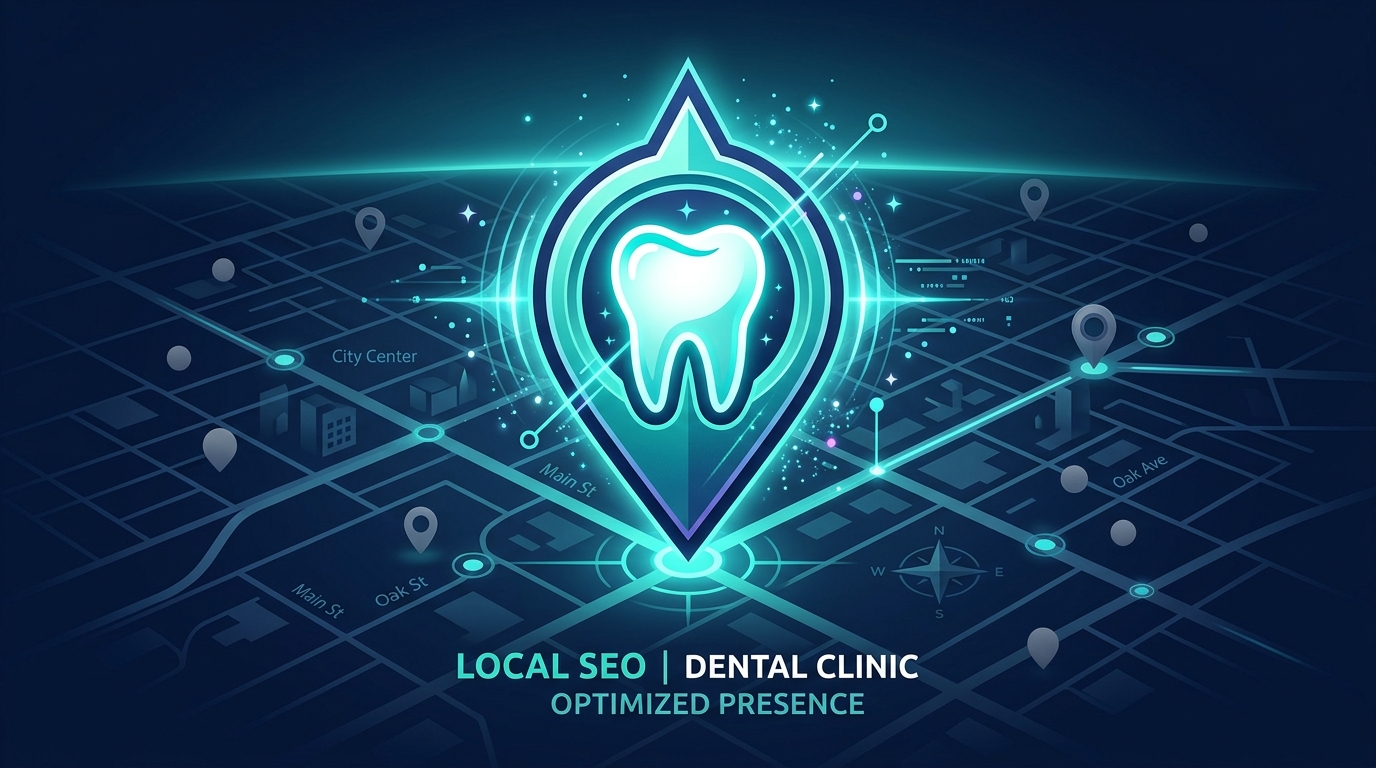
Your dental practice has great reviews, a friendly team, and appointment slots to fill. But when someone nearby searches "dentist near me," you're nowhere on the map. Meanwhile, a competitor with a weaker reputation is booking the patients who should be yours.
The honest answer is this: Google can't recommend a practice it doesn't fully understand. Most dental practices don't lose local search because they're not good enough. They lose it because their Google Business Profile, website, and reviews aren't sending the right signals.
This guide breaks down exactly what local SEO means for a dental practice, why it directly drives new patient calls, and the specific fixes that move the needle fastest.
What Local SEO Actually Means for a Dental Practice
Local SEO is the work that gets your practice shown when someone nearby searches for dental care. It's different from general SEO because Google isn't just judging your website, it's judging your entire online footprint: your Google Business Profile, your reviews, your directory listings, and your website, all together.
For dentists specifically, this matters more than most industries. Google treats healthcare content as Your Money or Your Life (YMYL) content, meaning it applies extra scrutiny to trust and accuracy signals before ranking a practice's pages.
Three factors decide where you show up in Google's Local Pack, the three-listing map result at the top of local searches:
- Relevance: does your profile and content match what the searcher typed?
- Distance: how close is your practice to the person searching?
- Prominence: how well-known and trusted is your practice, based on reviews, links, and citations?
You can't do much about distance. Relevance and prominence are where the work happens.
🔍 Not Sure Why Your Website Isn't Ranking?
Get a FREE SEO Audit of your website. No jargon, no sales pitch. We'll show you exactly what's stopping you from appearing on Page 1.
Claim Your Free SEO Audit →Takes 30 seconds. Results delivered within 48 hours.
Why Your Google Business Profile Is Your Most Important Asset
From our experience working with dental clients in the US and AU, your Google Business Profile (GBP) usually gets more views than your actual website. It's the first thing a patient sees before they ever click through.
BrightLocal's local SEO guide for dentists points to GBP signals, profile completeness, category selection, and keyword-rich descriptions, as carrying more weight in Local Pack rankings than any single other factor.
Here's what most practices get wrong: they claim the listing, fill in the basics, and never touch it again. That's a missed opportunity. Here's what we see every time a practice actually maintains its GBP properly:
- Primary and secondary categories set correctly. "Dentist" as primary, then specific categories like "Cosmetic Dentist" or "Emergency Dental Service" if that's genuinely part of your practice.
- Every service listed, not just a generic description. Patients search for "dental implants" or "Invisalign," not "dental services."
- Photos updated regularly. Practices with active photo uploads tend to see stronger engagement on their listing than those that upload once and stop.
- Weekly Google Posts. Offers, new patient specials, and educational posts keep the profile active. An active profile is a stronger relevance signal than a static one.
- Booking link or messaging enabled, so a patient can act the moment they find you.
Reviews: The Trust Signal That Decides Who Gets the Call
Most business owners we talk to underestimate just how much reviews influence both rankings and bookings. This isn't a "nice to have." It's often the single deciding factor for a new patient choosing between you and the practice down the road.
BrightLocal's annual Local Consumer Review Survey found that the vast majority of consumers say star ratings factor into their decision, and a meaningful share won't even consider a business with fewer than 20 reviews. Separately, a PatientPop patient survey found that most patients cite online reviews as the most important step in choosing a new dentist, and practices sitting below a 4.0 average lose a large share of prospective patients before the phone ever rings.
Recency matters as much as volume. Google's algorithm weighs fresh reviews more heavily than old ones. A practice with 50 reviews from two years ago can be outranked by a competitor with 30 reviews from the last quarter.
What actually works:
- Build review requests into your patient checkout process. Don't leave it to memory.
- Send the request while the experience is fresh, same day or next day, via SMS or email with a direct link.
- Respond to every review, positive or negative. A calm, professional reply to a negative review often builds more trust than the review itself damages.
- Don't cluster requests. A sudden spike of 30 reviews in one week looks unnatural to Google's systems. Steady and consistent beats a review-drive campaign.
NAP Consistency: The Boring Fix That Moves Rankings
NAP stands for Name, Address, Phone, and it needs to be identical everywhere your practice is listed: your website, your GBP, Yelp, Healthgrades, insurance directories, and dental association listings.
This sounds trivial. It isn't. From our experience running local SEO for service businesses, inconsistent NAP is one of the most common issues we find in a first-time audit: a practice that moved offices two years ago and never updated half its directory listings, or a phone number that changed and only got fixed on the website.
Tools like Moz Local or BrightLocal's citation tracker can surface every place your business is listed and flag mismatches. Fixing these is unglamorous work, but it directly affects how much Google trusts your business identity, and trust is what prominence is built on.
Location and Service Pages That Actually Convert
If your website has one generic "Services" page listing everything you do in a paragraph, you're leaving rankings on the table. Google, and patients, respond better to dedicated pages built around what someone is actually searching for.
For a single-location practice, this means:
- A dedicated page per major service (implants, Invisalign, root canals, cosmetic dentistry) with real detail: what it involves, what it costs on average, recovery expectations, and financing options if you offer them.
- Location-specific language naturally worked into your homepage and About page: your neighbourhood, nearby landmarks, the suburb or city you serve.
Multi-location practices need a separate page per location, each with its own GBP. Trying to rank one page for two cities usually backfires. Google will pick one and demote the other.
Avoid duplicating the same template across multiple location pages with only the city name swapped. Google's quality systems are built to catch this pattern, and it can suppress the whole site rather than just the thin pages.
🔍 Still Not Sure Where the Gaps Are in Your Own Listings?
Let us do the digging. A Free SEO Audit from Get Locably checks your GBP, citations, and site structure in one pass. No obligation, no sales call.
Get My Free SEO Audit →How Long Local SEO Takes to Show Results
We won't oversell this. Local SEO is not instant. From our experience with dental clients, most practices start seeing measurable movement in Local Pack visibility within 3 to 6 months of consistent work: GBP optimization, review generation, and citation cleanup together, not just one piece.
Full competitive rankings for high-value keywords in a crowded metro market can take 6 to 12 months. The upside is durability. Once you've built genuine authority, real reviews, consistent citations, useful content, that visibility doesn't disappear the moment you stop paying for ads. It compounds.
Be wary of any agency, including us, that promises page-one rankings in weeks. That's not how Google's algorithm works, and a guarantee like that is usually a sign of shortcuts that put your practice at risk later.
Conclusion
Local SEO for a dental practice isn't one trick. It's your Google Business Profile, your reviews, your citation consistency, and your website content all reinforcing the same message to Google: this practice is real, active, and trusted nearby. Get those pieces working together, and the patients who are already searching for a dentist tonight start finding you first.
Ready to See What's Holding Your Practice Back?
You've just read what actually moves the needle for dental local SEO. The next step is finding out exactly where your practice's own listings and website stand right now.
Get a free, no-obligation SEO audit from the team at Get Locably. We'll check your GBP, your citations, and your site, then send you a plain-English report on what to fix first.
Get My Free Dental SEO Audit →FAQ
Costs vary by market and competitiveness, typically ranging from a few hundred to several thousand dollars a month depending on scope. Basic GBP and citation work costs less than a full content and link-building program. Ask any agency for a breakdown of exactly what's included before committing.
Yes, to a point. Claiming and optimizing your GBP, requesting reviews, and fixing NAP consistency are all things a practice manager can handle in-house. Content strategy, technical SEO, and multi-location work usually benefit from specialist help as the practice grows.
Yes. A calm, professional response shows prospective patients, and Google, that the practice takes feedback seriously. Never argue publicly or share patient details in a response. Keep it brief and offer to resolve the issue offline.
There's no fixed number, but practices competing in busy markets typically need well over 50 reviews with a strong average rating to compete for top Local Pack spots. Less competitive markets can rank with fewer.
Yes. Each physical location needs its own GBP and its own dedicated page. Trying to rank one page for multiple cities usually causes Google to pick one and suppress the other.
Patients are increasingly asking tools like ChatGPT or Google's AI Overviews for dentist recommendations before running a traditional search. According to Thrive Agency's dental marketing research, patients now research treatments like Invisalign and implants through AI search tools before ever running a traditional search. These tools draw on the same trust signals, reviews, consistent listings, clear service information, that drive traditional local rankings, so the fundamentals still apply.
Written by the Get Locably Team
Get Locably is a digital marketing agency specialising in SEO for small and medium businesses across the United States and Australia. Our team has helped dental clinics, service businesses, and e-commerce brands rank higher on Google and convert visitors into paying customers.
Get a Free SEO Audit of Your Website